From Global Dialogue to Local Action:
Servas International Observes the International Day of Peace 2026
Theme: “Invest in Peace – For Everyone, Everywhere, Every Day”
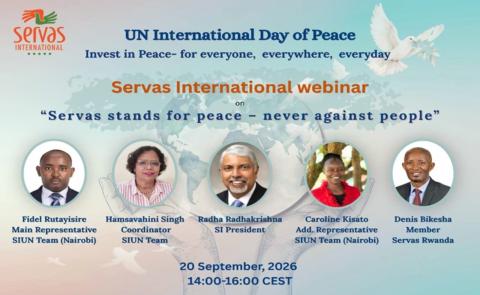
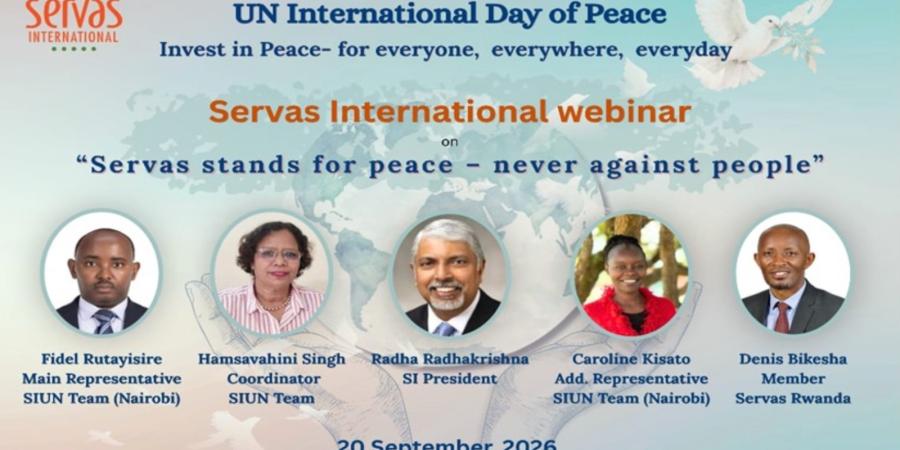
In observance of the United Nations International Day of Peace, Servas International organised a webinar on 20 September 2026, bringing together Servas members, representatives and peace advocates from different parts of the world. Held on the eve of the International Day of Peace, the webinar explored how global commitments to peace can be translated into meaningful action in our homes, schools and communities.
Under the theme “Invest in Peace – For Everyone, Everywhere, Every Day,” the programme highlighted the importance of grassroots initiatives, intercultural understanding, gender equality, environmental responsibility and positive parenting. Through presentations and an interactive exchange, the speakers demonstrated that peace is not merely an ideal but a continuing commitment that requires participation, cooperation and collective responsibility. The webinar was moderated by Aditya Divya Singh and coordinated by Dr. Hamsavahini Singh, Coordinator of the Servas International UN Team.
Welcoming the participants, Aditya Divya Singh emphasised that peace must be actively nurtured through dialogue, understanding, inclusion and everyday actions. Investing in peace, she observed, means dedicating our time, attention, resources and energy towards building a better collective future. Peacebuilding must begin at home, extend to our communities and include our relationship with nature. Following a minute of silence in remembrance of all those affected by conflict and violence, she introduced Radha Radhakrishna, President of Servas International, as the first speaker.
Radha, who has been associated with Servas for over 35 years, presented an overview of the organisation's history, mission and initiatives. Founded in 1949 by Bob Luitweiler in the aftermath of the Second World War, Servas was envisioned as a platform through which people from different countries and cultures could meet, build friendships and contribute to a more peaceful world. Today, Servas has approximately 16,000 members across more than 100 countries and is managed entirely by volunteers.
Highlighting hosting and travelling as the organisation's principal activities, Radha explained how meaningful intercultural exchanges help develop mutual understanding and lasting friendships. He also introduced initiatives under Servas's Building Connections programme, including Peace Schools, youth and family events, the S.I.L.E. programme, activities supporting the United Nations Sustainable Development Goals (SDGs), women's empowerment and environmental protection. Emphasising that many initiatives originate from members themselves, he encouraged greater participation, fresh ideas and collaboration. He reminded everyone that building peace requires sustained engagement and shared responsibility at individual and community levels.
Taking the discussion from Servas's grassroots philosophy to its international engagement, Dr. Hamsavahini Singh presented “From Global Dialogue to Local Action.” She introduced the work of Servas representatives at the four United Nations locations—New York, Geneva, Vienna and Nairobi—and explained how their responsibilities extend beyond representing Servas at international forums. They observe global developments, identify relevant issues, communicate the organisation's values, build partnerships and bring important discussions back to the wider membership and local communities.
She outlined the areas of engagement of the four locations, including gender equality, human rights, peace and security, sustainable development and environmental protection. Although each location has its own focus, the representatives work collectively through regular communication, information-sharing and joint initiatives. Describing their work as a continuous cycle of listening, representing, connecting, communicating and initiating action, she emphasised that international dialogue must lead to practical outcomes. Webinars, NGO networks and partnerships provide opportunities to make UN developments accessible to Servas members and encourage their involvement.
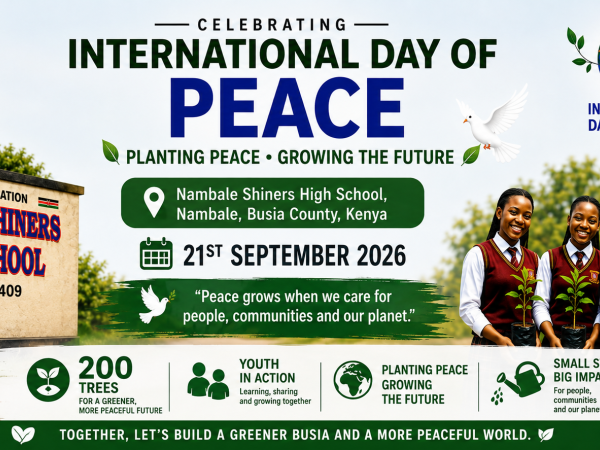
A significant example of this approach is the Trees for Peace initiative at Nambale Shiners High School in Busia County, Kenya. Linking the project to SDGs 11, 13, 16 and 17, Dr. Singh demonstrated how international commitments can inspire grassroots action by bringing together students, teachers, local partners and Servas representatives. She described the SI UN Team as a bridge between international institutions and local communities, emphasising that understanding strengthens peace and cooperation sustains it.
The importance of building peace within families and relationships was further explored by Fidèle Utayisire, Servas International Main Representative to the UN Office at Nairobi, in his presentation “Investing in Peace Starts at Engaging Men to Transform Relationships.” Drawing on the work of the Rwanda Men’s Resource Centre (RAMREC), he highlighted the role men and boys can play as active partners in preventing gender-based violence, promoting gender equality and building peaceful families.
He introduced the Bande Berejo programme, which engages men and couples through structured sessions and dialogue to challenge harmful gender norms, address unequal power relationships, encourage positive fatherhood and promote shared household responsibilities. Sharing encouraging results, Fidèle referred to reductions in physical, sexual and psychological violence within participating households. He also spoke about RAMREC's work in Mahama Refugee Camp in Rwanda, where engaging men, couples and young people helps promote peaceful coexistence between refugee and host communities. His presentation reinforced the message that peacebuilding begins at home, through respect, equality, care and cooperation in everyday relationships.
From the family as a foundation of peace, the discussion moved naturally to the wider community and its relationship with the environment. Caroline Kisato, Servas International Representative at the UN Office at Nairobi, presented the “Trees for Peace” initiative at Nambale Shiners High School. The project combines environmental protection, education and community participation, with particular attention to vulnerable students, including teenage mothers and children facing social and economic challenges.
Through planting and caring for indigenous and fruit-tree seedlings, students are encouraged to develop environmental awareness, responsibility and a sense of belonging. CKL Africa contributed 200 seedlings, while an additional 43 fruit-tree seedlings were purchased for the school. The initiative also envisages developing a school orchard and exploring possibilities for fruit processing and income generation, thereby connecting environmental protection with nutrition, livelihoods and community resilience.
Caroline explained that the project is intended to be a continuing process rather than a one-day activity. By nurturing and monitoring their trees, students will develop a deeper understanding of their environment and their responsibility towards future generations. The initiative also seeks to address local environmental challenges, including flooding, and encourage wider community participation. She expressed the hope that the model could be replicated in other schools through partnerships and collaboration. Her message was particularly meaningful: as children nurture their trees, they too grow in responsibility, awareness and commitment to their communities.
The focus on nurturing the next generation was taken further by Professor Denis Bikesha, Associate Professor of Transitional Justice at the University of Rwanda and founder of Lead for Tomorrow Rwanda, in his presentation “Peacebuilding through Positive Parenting.” He highlighted how positive parenting, particularly during early childhood, can help prevent violence and nurture a culture of peace.
Lead for Tomorrow works in five African countries—Rwanda, Kenya, Uganda, Tanzania and Zimbabwe—bringing families together for structured parenting sessions while supporting community leadership and income-generating activities, particularly for women. Professor Bikesha shared the experience of Lead Hill School in Kigali, established in 2021 as a demonstration peace school. Beginning with just seven pupils, it has grown to 200 children in 2026, supported by 13 teachers. The school combines positive parenting with a supportive learning environment and provides partial or full sponsorship to 21 children from economically disadvantaged families.
He also outlined plans to expand peace schools and parenting programmes, train more parents and teachers, strengthen mediation initiatives and support teenage mothers. His central message was that peaceful societies are built by nurturing children, strengthening families and creating safe, supportive communities. Investing in positive parenting is therefore an investment in the next generation and a more peaceful future.
The presentations were followed by an engaging exchange with participants, bringing together the different dimensions of peacebuilding discussed during the webinar. Responding to questions about translating international engagement into practical action, Dr. Singh explained how the four UN locations work together through information-sharing, webinars and collaborative initiatives. She cited Trees for Peace as an example of bringing global priorities to local communities, while Radha encouraged greater involvement of Servas members in advancing the Sustainable Development Goals at the grassroots level.
The discussion also highlighted the Servas Peace School initiative, which originated with Mehmet in Ekinci, Türkiye, and is now in its nineteenth year. Inspired by this model, similar initiatives have emerged in Uganda, Georgia, Argentina and Colombia. Dr. Singh shared her experience of the Peace School in Türkiye, emphasising the importance of intercultural friendships and involving young people in peacebuilding. Caroline also shared photographs from the Trees for Peace project, reiterating that nurturing trees would be a continuing learning experience for the students.
In her closing remarks, moderator Aditya Divya Singh brought together the central messages of the presentations. She reminded participants that peacebuilding begins at home, in our relationships, in the way we nurture children and in our actions towards our communities and environment. Whether through intercultural exchange, transforming gender relationships, positive parenting or planting a tree, every meaningful action contributes to a more peaceful world. She encouraged everyone to turn reflection into meaningful action and make peace an everyday commitment.
On behalf of Servas International, she thanked all the speakers and participants, particularly Dr. Hamsavahini Singh for coordinating the webinar, and Caroline Kisato and Fidèle Utayisire for their support in making the programme possible.
The webinar concluded with a renewed commitment to the theme, “Invest in Peace – For Everyone, Everywhere, Every Day.” It reaffirmed that peace is not solely the responsibility of governments or international institutions, but a shared responsibility that begins with each of us—in our relationships, our choices, our communities and our care for the environment.
Through its global network and grassroots initiatives, Servas continues to demonstrate that meaningful peacebuilding is possible when people connect, collaborate and take responsibility for the world they share.
BY: Hamsavahini Singh, coordinator of SI UN Team, on behalf of the members present at this webinar
Join & support
Articles you might be interested in

International day of Peace 2023
2023-09-28
SI at Nuclear Ban Week in New York
2023-11-29
Servas Women- Who are we?
2024-11-06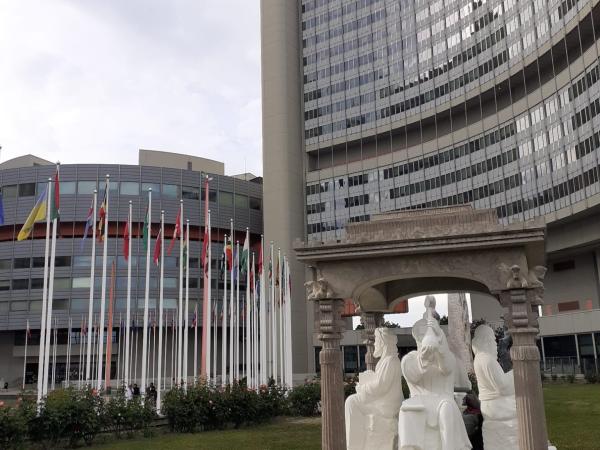

Peace Week- Trees for Peace/SI UN T
2026-09-04
SI UN NY Event The Work of Peace
2026-09-05